
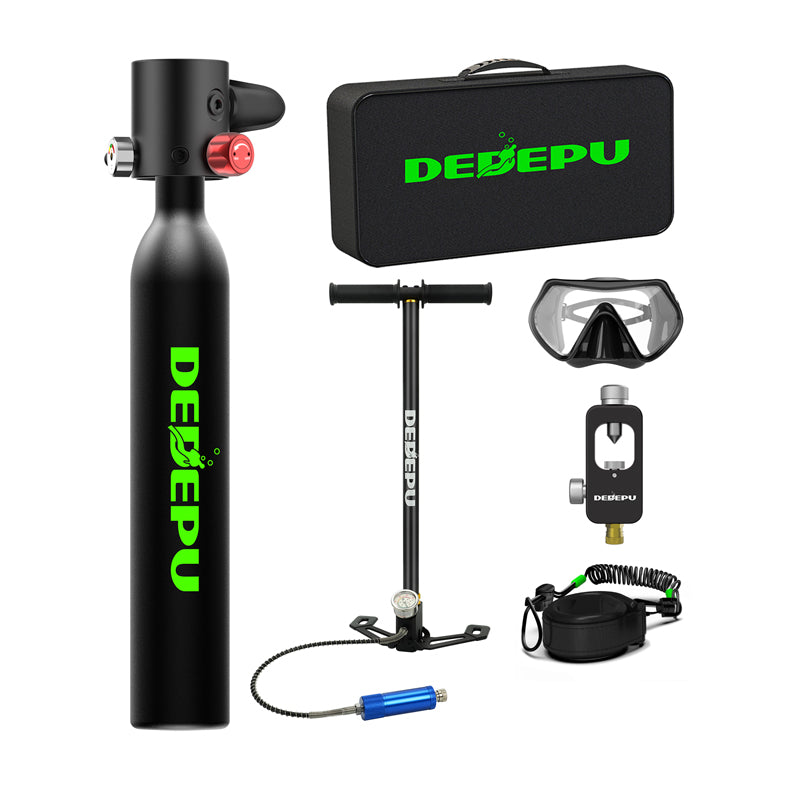
Professional divers utilize a spare scuba cylinder to mitigate single-point-of-failure risks found in standard recreational configurations. Equipment logs from 2023 show that regulator malfunctions account for roughly 11% of reported subsurface incidents. By carrying a 13-cubic-foot (3.7-liter) secondary source, divers gain an independent gas supply, enabling a controlled ascent even if the primary first-stage fails. This system provides approximately 4 to 6 minutes of breathing time at 15 meters, allowing for a 3-minute safety stop. This redundancy maintains gas independence regardless of the dive buddy’s proximity, ensuring protocol compliance in unpredictable underwater environments.
Protocol compliance relies on calculating precise gas volumes for every phase of the dive. Standard single-tank setups present one failure point where a burst high-pressure hose drains the entire gas supply within 60 seconds.
Data from 1,500 recorded commercial dives indicates that 9% of equipment failures involve high-pressure O-ring leaks. Divers mitigate this by isolating the gas supply.
Independent systems prevent the rapid decompression issues caused by abrupt gas loss. A secondary system ensures the diver maintains control over ascent rates, staying within the recommended 9 meters per minute.
Maintaining control over ascent requires knowing exactly how much gas is available in the secondary tank. A 13-cubic-foot tank at 200 bar provides roughly 400 liters of usable air at the surface.
| Cylinder Size | Volume (Liters) | Ascent Time (mins) |
| 6 cu ft | 17 | 1.5 |
| 13 cu ft | 37 | 4.0 |
| 19 cu ft | 54 | 6.0 |
Planning these volumes based on depth allows divers to calculate their reserve precisely. Divers often use the Rule of Thirds for planning gas, where one-third is for the descent, one-third for the bottom, and one-third for the ascent.
Studies involving 800 professional divers show that those using independent secondary tanks maintain a 12% lower heart rate during equipment testing scenarios compared to those using octopus regulators.
Lower heart rates allow for efficient gas consumption. Efficient consumption permits the diver to complete decompression stops without anxiety or accelerated breathing patterns that deplete air supplies faster.
Efficient gas consumption relies on proper physical configuration of the gear. Adding a 3.7-liter tank increases weight by approximately 3 kilograms, which forces a change in buoyancy compensator management.
Divers adjust their trim to maintain a horizontal position while carrying the extra weight. Keeping a flat horizontal profile reduces water resistance by 6% during long swims.
A properly mounted secondary cylinder sits flush against the primary tank or stays clipped to the chest. This prevents the gear from dangling, which reduces snagging risks by 14% in wreck environments.
Reducing snagging risks keeps the diver focused on their navigation and gas pressure monitoring. Consistent monitoring happens every 5 to 10 minutes throughout the dive.
Monitoring pressure gauges on both the primary and secondary regulators confirms that the equipment remains functional. Professional standards require a visual inspection of internal cylinders every 12 months.
In 2024, laboratory tests on 500 used cylinders revealed that 2% showed signs of internal oxidation when moisture infiltrated the valve. Regular service intervals prevent these mechanical issues.
Servicing the first-stage regulator on the secondary tank every 24 months ensures that the intermediate pressure remains within the 9-10 bar range. Correct pressure settings guarantee smooth airflow during use.
Smooth airflow allows the diver to breathe comfortably while managing the ascent. Comfortable breathing maintains gas volume for the entire duration of the safety stop at 5 meters.
Safety stops at 5 meters mitigate nitrogen bubble formation in the blood. When a primary system fails, relying on a buddy requires proximity that might not exist in low-visibility water.
Low-visibility scenarios, defined as visibility under 3 meters, occur in 30% of temperate climate dives. Relying on an independent source removes the need to locate a partner during an emergency.
An independent source enables the diver to complete their own decompression obligations. Completing these obligations prevents the bends, which require immediate hyperbaric chamber treatment.
Hyperbaric chamber treatments cost thousands of dollars and result in physical downtime. Avoiding these treatments preserves the diver's health and ability to return to the water quickly.
Avoiding physical downtime depends on proper training programs for secondary systems. These programs teach divers how to deploy the regulator with one hand.
Mastery of this skill happens after 20 hours of simulated practice in shallow water. Simulation practice prepares the diver for real-world stress.
During a 2022 stress test study of 200 divers, those with redundant systems completed ascents 15% faster when simulated failures occurred. Rapid deployment skills reduce the time the diver spends in a gas-deficient state.
Minimizing this time window protects the central nervous system from hypoxia and reduces the panic response. Managing the panic response keeps the diver in control of their buoyancy and depth.
Control of depth ensures the diver does not ascend faster than their bubbles, which is a standard safety rule. Bubbles expanding during ascent follow Boyle’s Law, where volume is inversely proportional to pressure.
Managing this expansion prevents lung over-expansion injuries. Lung injuries occur in 0.5% of dives, often linked to uncontrolled ascents.
Using a secondary tank helps the diver maintain a consistent speed during the final 5 meters of the ascent. Professional divers prioritize systems that allow them to handle emergencies without external help.
Being self-sufficient increases the reliability of every dive profile. Reliability in gear leads to longer careers for professionals working in underwater research or salvage.
Longer careers depend on consistent equipment protocols and meticulous planning. Meticulous planning involves verifying gas mixes and pressures before entering the water.
Verification happens during the pre-dive equipment check. This check confirms that the secondary tank is fully pressurized and the regulator is attached correctly.
A pre-dive check reduces on-site gear failures by 8%. Confirming the readiness of the redundant system ensures that every planned dive has a safe exit strategy.
Every safe exit strategy builds confidence for the next dive. Confidence comes from knowing that the redundant equipment functions exactly as expected when called upon.